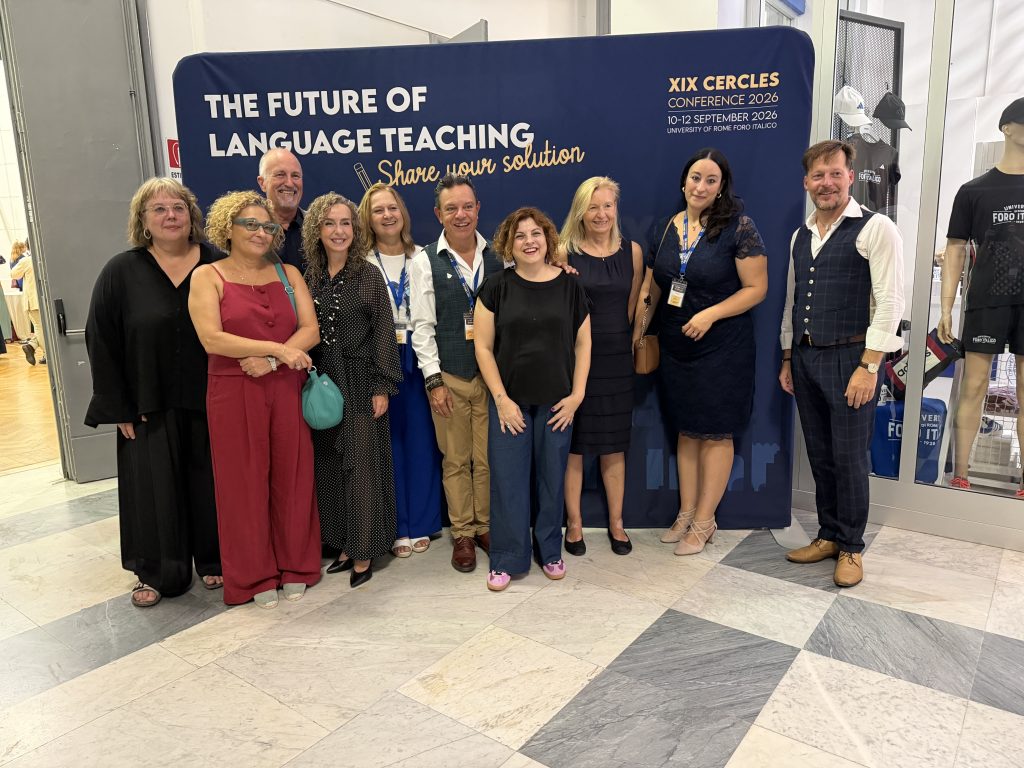
406 participants from 173 universities came together at the University of Rome Foro Italico for three days of research, dialogue and exchange on the changing role of languages and University Language Centres.
These are some of the numbers that tell the story of CercleS 2026, the XIX International CercleS Conference hosted by the University of Rome Foro Italico from 10 to 12 September.
We were honoured to welcome such a broad and diverse international community to a conference that aimed, from the outset, to be a genuine expression of multilingualism, multiculturalism, dialogue and exchange.
At a time of deep technological, social and cultural transformation, CercleS 2026 invited us to reflect on the evolving role of University Language Centres: no longer simply providers of language teaching, but strategic actors in internationalisation, inclusion, mobility, scientific cooperation and the development of multilingual and intercultural competences.
Over three days, the conference brought together 190 contributions across presentations and workshops, alongside 20 posters, three of which received awards. Together, they reflected the variety of research, professional practice and innovative approaches being developed across universities and Language Centres in many different countries.
One of the distinctive features of the programme was the way in which the four keynote lectures and the closing endnote were conceived as complementary parts of the same conversation. Rather than approaching language education from a single perspective, they created a journey through its institutional history, its future in the age of AI, assessment, its broader social and cultural meaning, and the changing world of language testing.
Carmen Argondizzo opened this journey by looking back at the development of CercleS itself, tracing both its organisational growth and its pedagogical evolution. Her diachronic analysis was not simply historical: it connected the experience accumulated by the European community of Language Centres with the societal expectations and future directions that now lie ahead.
From this long-term perspective, Mike Mayor moved directly into one of the most urgent challenges facing education today: how language learning can remain relevant in the age of generative AI. His focus on AI literacy, critical thinking, communication, collaboration and empathy led to a particularly significant idea: in a world where skills rapidly become obsolete, learning to learn may itself be the essential skill that universities need to develop.
 Neus Figueras Casanovas then brought the discussion into the field of assessment, challenging the idea of testing as an isolated final stage and placing it instead within a holistic learning system, connected with curricula, teaching methodologies, learning processes and the CEFR. Her contribution highlighted how assessment can become an integral part of high-quality language education rather than simply a tool for measuring its outcomes.
A deliberately different perspective came from Francesca Romana Lenzi. Moving beyond the more familiar pedagogical and technical approaches to language education, her keynote brought sociology, epistemology and hermeneutics into the discussion. Language was explored not merely as a means of transferring information, but as a space of encounter, interpretation and participation in a community of discourse. Her reflection also addressed the crisis of public language, the fragmentation created by social media and the impact of generative AI, placing language education within a broader social, cultural and civic responsibility. It was an original change of perspective that widened the scope of the conference and reminded us why language matters far beyond the classroom.
Finally, Javier Fruns Giménez brought the discussion back to language testing, but now viewed through the transformations affecting contemporary society and technology: new dimensions of communicative competence such as mediation, digital testing environments, accessibility for candidates with special needs, fairness and fraud prevention, and the growing contribution of AI to scoring and test analysis. His endnote closed the circle by asking how innovation can be embraced without losing sight of the validity, reliability and quality of assessment.
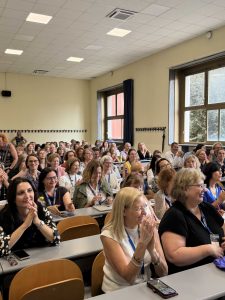 Different perspectives, but one shared question: how can language education respond meaningfully to a world that is changing so rapidly?
Perhaps the most important outcome of these three days, however, goes beyond numbers and programmes. Internationalisation is, above all, about people: meeting one another, listening to different perspectives, sharing knowledge and creating new connections. Languages make those encounters possible and allow us not only to communicate, but to understand one another.
A special thank you goes to the CercleS Executive Committee, who believed in our proposal and supported us throughout the organisation of this conference, bringing CercleS back to Italy after ten years. It was an honour for the University of Rome Foro Italico to welcome the CercleS international community and to help create a space where languages, cultures, experiences and perspectives could meet.
Our sincere thanks also go to everyone who took part: speakers, poster authors, delegates and participants who shared research and projects, asked questions, exchanged ideas and contributed to the discussions. It is this diversity of languages, cultures and approaches that gave the conference its real meaning.
In the coming days, we will return to some of the stories, ideas and experiences that left a particular mark on CercleS 2026 – those that made us think, opened up new perspectives and deserve to be shared.
Thank you for being with us in Rome.
articolo di Paola Claudia Scioli